

Caregiver burnout can develop gradually as Dementia care needs increase. Recognizing the signs early can help families build a more sustainable plan for care at home.
Caregiver burnout after a Dementia diagnosis
Think of family caregiving like carrying a backpack.
At first, you barely notice the weight.
A medication reminder goes into the backpack. Then transportation to appointments. Then help with meals. Then bathing and dressing. Then repeated questions, disrupted sleep, wandering concerns, changes in behavior, financial decisions, and the constant awareness that something could happen if you are not paying attention.
No single responsibility necessarily feels impossible.
The problem is that nobody keeps taking things out of the backpack.
Eventually, even the strongest person begins to buckle under a weight they once believed they could carry indefinitely.
That is often how caregiver burnout develops after a diagnosis of Alzheimer’s disease or another form of Dementia. It rarely arrives as one dramatic moment. More often, exhaustion, anxiety, responsibility, and grief accumulate quietly until the person providing care realizes that their own health, relationships, work, or ability to function have begun to change.
And the numbers show just how significant that burden can become.
According to the Alzheimer’s Association 2026 Alzheimer’s Disease Facts and Figures, nearly 13 million Americans provide unpaid care to someone living with Alzheimer’s or another Dementia. In 2025 alone, those caregivers provided more than 19 billion hours of unpaid care, valued at more than $446 billion. The Alzheimer’s Association also reports that 59% of Dementia caregivers experience high to very high emotional stress.
Caregiver burnout deserves to be treated as more than simply “being tired.”
Sometimes, it is a warning that the current care plan is no longer sustainable.
What Is Dementia Caregiver Burnout?
Caregiver burnout is a state of significant physical, emotional, or mental exhaustion associated with prolonged caregiving demands.
A family member can deeply love the person they are caring for and still become overwhelmed.
In fact, some of the most committed family caregivers may be particularly vulnerable because they continue absorbing new responsibilities long after additional support should have been introduced.
The Alzheimer’s Association identifies warning signs of caregiver stress that can include exhaustion, sleeplessness, irritability, anxiety, social withdrawal, difficulty concentrating, and health problems. When symptoms occur regularly, the organization recommends speaking with a physician. The important distinction is this:
One difficult day can happen to anyone. A persistent pattern deserves attention.
10 Signs of Dementia Caregiver Burnout Worth Paying Attention To
Watch for changes such as:
- Persistent exhaustion that does not resolve after a normal night’s sleep.
- Irritability or frustration, particularly during repetitive or difficult care situations.
- Social withdrawal from friends, hobbies, family, or activities you previously enjoyed.
- Sleep disruption, including difficulty falling or staying asleep because you remain alert for falls, wandering, confusion, or nighttime needs.
- Anxiety about what comes next as your loved one’s condition changes.
- Difficulty concentrating or making decisions that normally would not feel difficult.
- Neglecting your own health, including appointments, exercise, nutrition, medications, or other personal needs.
- Frequent physical symptoms, such as headaches, stomach problems, muscle tension, or other concerns that may accompany chronic stress.
- Feelings of resentment, guilt, or emotional numbness surrounding caregiving.
- A persistent sense that you cannot continue at the current pace.
Experiencing one of these occasionally does not necessarily mean someone is experiencing caregiver burnout.
Several occurring repeatedly over time may signal that something needs to change.
If caregiver stress has progressed beyond exhaustion into persistent sadness, hopelessness, severe anxiety, or other concerning changes in your mental or physical health, speak with your healthcare provider. Caregiver health matters, too, and seeking professional support should be part of the care plan when needed.
Why Dementia Caregiving Can Become So Demanding
Dementia caregiving is different from simply helping an older adult with household tasks.
As cognitive changes progress, a family caregiver may simultaneously become a:
- Companion
- Safety monitor
- Transportation coordinator
- Medication reminder
- Appointment scheduler
- Personal-care assistant
- Advocate
- Behavioral detective
- Financial organizer
- Decision-maker
- Overnight safety net
The responsibilities may continue evolving as Dementia progresses.
Someone who initially needed help remembering appointments may eventually require assistance with bathing, dressing, toileting, eating, mobility, communication, medication routines, safety, or continuous supervision.
The Alzheimer’s Association has reported an association between increasing limitations in activities of daily living and instru
mental activities of daily living and additional hours of family caregiving.
That is why a care arrangement that worked six months ago may no longer be appropriate today.
Dementia changes. The care plan should be able to change with it.

Caregiver burnout rarely comes from one responsibility. As Dementia progresses, medications, personal care, safety monitoring, nighttime needs, and other responsibilities can accumulate until one family member is carrying too much.
What Actually Helps Prevent Caregiver Burnout?
There is no universal solution to caregiver stress. Every family, diagnosis, home environment, and support system is different.
There are, however, several ways families can make caregiving more sustainable.
-
Introduce Respite Before There Is a Crisis
Respite care allows another trusted person or professional to temporarily assume caregiving responsibilities.
That might mean only several hours each week.
It does not necessarily mean transitioning to full-time professional homecare or relinquishing the family’s role.
The Alzheimer’s Association notes that respite services can provide caregivers with time to rest, exercise, attend appointments, run errands, spend time with friends and family, or simply step away while the person living with Dementia continues receiving support.
Sometimes a few reliable hours can create breathing room before exhaustion becomes crisis.
-
Build a Care Team Instead of Relying on One Person
Dementia care should not depend entirely on the stamina of one family member.
Determine which responsibilities can realistically be shared among relatives, friends, physicians, nurses, community resources, and professional homecare providers.
The objective is not to remove the family.
It is to prevent one person from becoming the entire care system.
-
Protect the Family Caregiver’s Health
Keep your own medical appointments.
Protect sleep whenever possible.
Exercise.
Eat consistently.
Maintain relationships outside caregiving.
Continue doing some of the things that make you feel like yourself.
These are not indulgences.
They help preserve your ability to continue supporting someone else.
-
Learn the Disease, Not Just the Tasks
Understanding why a person living with Dementia is behaving differently can change the way families respond.
Repetition, resistance, apathy, agitation, wandering, changes in judgment, and communication difficulties may reflect changes occurring within the brain rather than intentional behavior.
Specialized Dementia education can help families move from simply reacting to a behavior toward asking a better question:
What might this person be trying to communicate through the behavior I am seeing?
That shift can change an interaction.
Sometimes, it can change an entire care relationship.
-
Reassess the Care Plan as Needs Change
Do not wait for a hospitalization, fall, wandering event, medication problem, or family crisis to reconsider how much support is being provided.
Periodically ask:
“If we were designing Mom or Dad’s care plan from scratch based on their needs today, would we still design it this way?”
If the answer is no, the care plan deserves another look.
When Parkinson’s Disease Is Part of the Picture
Caregiver strain is not exclusive to Dementia.
Families supporting someone living with Parkinson’s disease may encounter a different combination of challenges, including mobility changes, freezing episodes, fall risk, medication timing, changes in speech or swallowing, increasing assistance with activities of daily living, and, for some individuals, cognitive changes.
When Parkinson’s disease and cognitive impairment coexist, caregiving can become particularly complex.
That is one reason specialized care matters.
A Care Professional supporting someone living with Parkinson’s disease should understand more than general personal care.
Likewise, someone supporting a person living with Dementia should have education specific to cognitive change, communication, behaviors, safety, routines, and meaningful engagement.
The diagnosis changes the care. Training should reflect that.
Specialized Dementia and Parkinson’s Care at Home
At Angels on Call Homecare, our goal is not simply to place someone in a home.
It is to build the right support around the person and the family.
Our approach combines trained Care Professionals, RN clinical oversight, specialized Dementia and Parkinson’s education, and individualized care planning designed to help people continue living with greater dignity, safety, purpose, and connection at home.
Depending on the individual and family’s needs, support may include:
- Respite and hourly homecare to give family caregivers reliable periods of relief and additional support at home.
- Memory Care Angel (MCA) support for individuals requiring more advanced Dementia-focused care.
- Guardian Angel Visits, providing specialized RN involvement for individuals and families navigating Dementia.
- Guardian’s Guide consultations to help families better understand changing needs, risks, and potential next steps.
- Passions Unveiled, an individualized approach to meaningful engagement built around the person’s identity, history, interests, abilities, and what continues to give life meaning.
- Specialized Parkinson’s care at home, supported by Parkinson’s-specific professional education and clinical expertise.
- Live-in and extended-hour homecare when several hours of weekly assistance are no longer enough.
The purpose is not to replace the family.
It is to strengthen the family around the person they love.
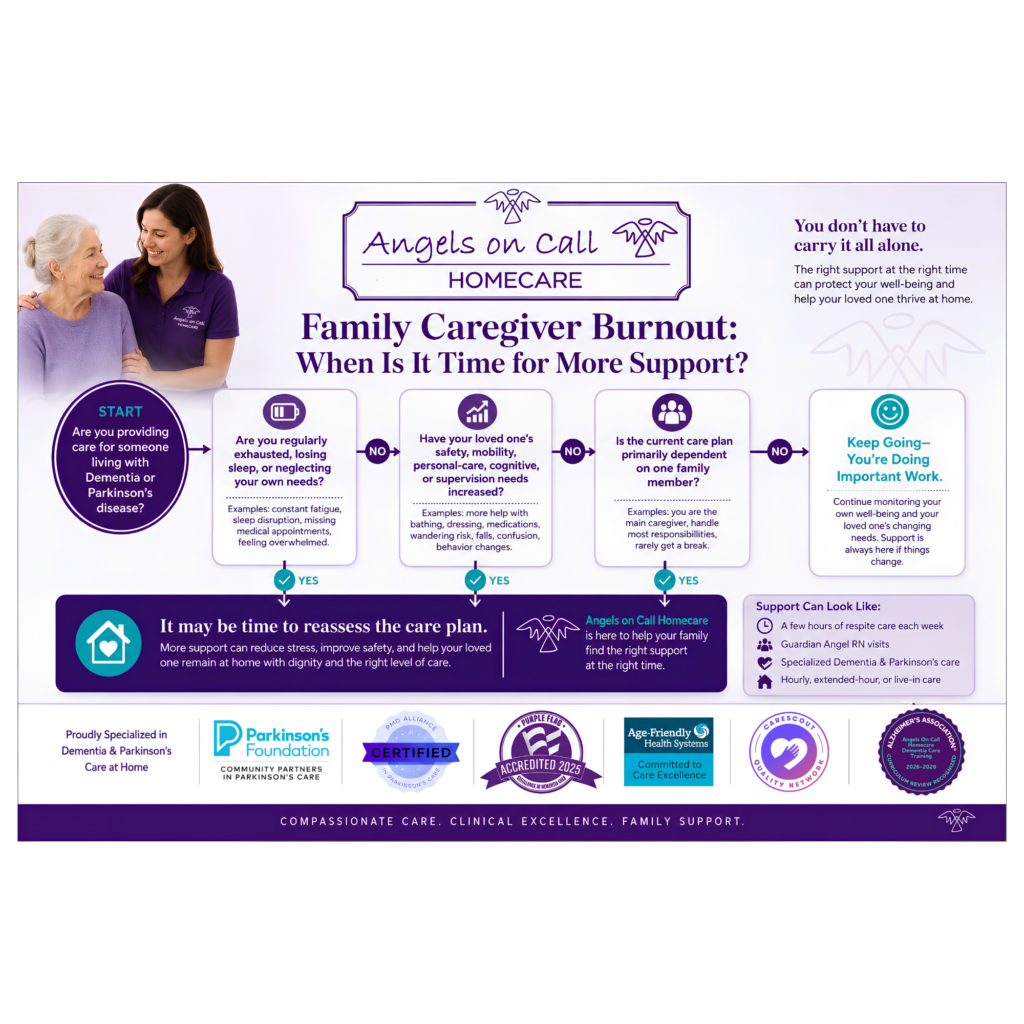
Frequently Asked Questions About Dementia Caregiver Burnout
What are the first signs of caregiver burnout?
Early warning signs can include persistent fatigue, irritability, anxiety, difficulty sleeping, social withdrawal, difficulty concentrating, physical symptoms, and neglecting your own health or relationships. When several symptoms persist rather than occurring occasionally, it may be time to reassess the caregiving situation and seek additional support.
Does needing respite care mean I can no longer care for my parent?
No. Respite care can help make continued family caregiving more sustainable. Temporary professional support can give a family caregiver time to rest, work, attend appointments, spend time with other family members, or simply recharge while their loved one continues receiving care. (https://www.alz.org/help-support/caregiving/care-options/respite-care)
How many hours of homecare should we start with?
There is no universal number. The appropriate schedule depends on the person’s cognitive abilities, mobility, personal-care needs, safety risks, routines, family availability, home environment, and other factors. Some families may benefit from several hours of respite each week, while others may require daily, extended-hour, or live-in support.
Can homecare help someone with both Dementia and Parkinson’s disease?
Yes, but the provider’s training and experience matter. Parkinson’s disease and Dementia can each create distinct needs involving cognition, communication, mobility, medication routines, personal care, safety, and daily functioning. Families should ask prospective homecare providers specifically about their Dementia and Parkinson’s education, clinical oversight, and experience.
When should a family consider professional homecare?
Additional support may be appropriate when caregiving demands begin affecting the family caregiver’s health, employment, sleep, relationships, or ability to manage other responsibilities; when the person requires increasing assistance with activities of daily living; when safety concerns emerge; or when the family recognizes that the current arrangement cannot remain sustainable indefinitely.
Can someone remain at home as Dementia progresses?
Many people living with Dementia can continue aging in place when their home environment, supervision, clinical needs, safety considerations, and level of support are appropriate for their changing circumstances. Whether remaining at home is appropriate should be evaluated individually rather than determined by diagnosis alone.
Can caregiver burnout affect the person receiving care?
It can. Severe or prolonged caregiver stress may affect patience, communication, decision-making, consistency, and the caregiver’s own physical and emotional health. Supporting the family caregiver can therefore be an important part of supporting the person receiving care.
Is caregiver burnout a sign that memory care placement is necessary?
Not necessarily. Caregiver burnout is a signal that the current arrangement may need to change, but that change can take many forms. Additional family involvement, respite care, professional homecare, RN support, environmental modifications, increased hours of care, or other resources may help. Decisions about remaining at home or transitioning to another setting should be based on the individual’s overall needs, safety, preferences, and circumstances.
Asking for Help Is Part of the Care Plan
Families sometimes interpret accepting professional help as surrendering responsibility.
We see it differently.
If you were responsible for keeping a bridge standing, you would not wait until the structure began collapsing before adding reinforcement.
Family caregiving deserves the same foresight.
The strongest care plans do not depend upon one exhausted person continuing indefinitely.
They create enough support around both the person receiving care and the people who love them that everyone has a better chance of remaining well.
And sometimes, accepting help allows a family member to reclaim something caregiving has slowly taken away:
the ability to be a daughter again instead of always being the caregiver.
Or a son.
Or a spouse.
Or simply someone who can sit beside the person they love without mentally running through the next ten things that need to be done.
That matters, too.
Looking for Dementia or Parkinson’s Homecare in New York?
Angels on Call Homecare is a privately owned, family-run New York homecare provider serving individuals and families navigating Dementia, Alzheimer’s disease, Parkinson’s disease, and the complexities of aging at home throughout New York’s Hudson Valley and surrounding service areas.
Our approach to homecare is built around individualized support, specialized professional education, RN clinical oversight, meaningful engagement, family partnership, and a belief that aging at home should mean more than simply remaining in a house.
It should mean continuing to be known, valued, connected, safe, and supported as a person.
You Don’t Have to Wait Until Caregiving Becomes a Crisis
If caring for someone you love is beginning to consume your sleep, health, work, relationships, or ability to simply be their son, daughter, spouse, or partner again, that is worth paying attention to.
The first step does not have to mean committing to full-time homecare.
Sometimes it begins with a much smaller question:
What could four, eight, or twelve hours of meaningful support each week change for our family?
Maybe it means sleeping without one ear open.
Maybe it means going back to the gym.
Making your own doctor’s appointment.
Having dinner with your spouse.
Taking your child somewhere without constantly checking your phone.
Or simply walking into Mom’s house and being able to sit down beside her instead of immediately beginning another shift.
You are still family. You do not have to become the entire care system.
If your family is navigating Dementia, Alzheimer’s disease, Parkinson’s disease, or increasing care needs at home, talk with the Angels on Call Homecare team about what support could look like.
We can help you explore specialized Dementia care, Parkinson’s care, respite care, RN-guided services, hourly homecare, extended-hour care, and other options designed around the individual—not simply the diagnosis.
Talk With Our Care Team
Explore Specialized Dementia & Parkinson’s Care at Home
About the Author
Eric J. Dalton
Eric J. Dalton is Vice President and Health Services Administrator of Angels on Call Homecare and creator of Aging in Place — Redefined.
His work centers on developing specialized home-based care models, professional education, and family-support systems for individuals living with Dementia, Alzheimer’s disease, Parkinson’s disease, and other complex aging-related needs.
At Angels on Call Homecare, Dalton has helped advance specialized Dementia and Parkinson’s care programs, professional training pathways, family education, and person-centered approaches designed to move homecare beyond task completion toward a deeper standard of dignity, identity, purpose, safety, and meaningful quality of life.
His work is grounded in a simple principle:
Aging at home should mean more than remaining in a house. It should mean continuing to be known, valued, connected, and supported as a person.
An Important Clarification About Angels on Call Homecare
Angels on Call Homecare in New York is independently and privately owned and operated.
Our New York organization is not affiliated with, owned by, associated with, a franchise of, or otherwise connected to any other company, provider, or organization using the name “Angels on Call,” “Angels on Call Homecare,” or a similar name in any other state.
Families researching our organization should look specifically for Angels on Call Homecare in New York and our official website, angelsoncallinc.com
Educational Disclaimer: This article “Caregiver Burnout after a Dementia Diagnosis” is provided for general educational and informational purposes only and is not intended to diagnose, treat, or replace individualized medical, mental-health, or professional advice. Care needs and circumstances vary by individual. Families should consult appropriate healthcare professionals regarding medical, cognitive, behavioral, safety, or mental-health concerns.