
Live-In Care vs. 24-Hour Home Care: Key Differences, Costs, and How to Choose
Live-in care and 24-hour homecare are often used interchangeably, but they are structurally different models — and the difference matters more than most families realize when they’re comparing options for the first time. Live-in care generally means one Care Professional, or a small consistent team, residing in the home across multiple consecutive days, with built-in rest periods overnight. 24-hour homecare means a rotating team providing continuous, awake coverage around the clock, including through the night. For families navigating Dementia or Parkinson’s care, that distinction directly affects continuity, cost, and how well the care model actually matches what’s happening at 2 a.m., not just at 2 p.m.
What Live-In Care Actually Means
Live-in care is a continuity-based support model. A Care Professional lives in the home for an extended period — often several consecutive days — sharing meals, routines, and the rhythm of daily life alongside your loved one. Federal and New York labor standards generally allow for a sleep and meal period during a 24-hour live-in shift, which is why a live-in Care Professional is typically supported to rest overnight rather than remain actively awake for the full duration.
That distinction sometimes concerns families the first time they hear it. It shouldn’t. In practice, live-in care is built around structured presence: active engagement and support throughout the day, standby availability overnight, and — critically — the kind of relational familiarity that comes from the same person or small team showing up day after day. For many households, that familiarity is not a comfort feature. It’s a stabilizing one.
What 24-Hour Homecare Actually Means
24-hour homecare uses a rotating team — commonly two to three Care Professionals across defined shifts — so that someone is awake, alert, and actively engaged in the home at every hour, including overnight. There is no built-in rest period for the person on duty; each Care Professional works and is relieved before their shift ends.
This model exists for a reason: some households genuinely need active overnight support. Frequent nighttime wandering, a real fall risk when getting up unassisted, significant overnight confusion, or medical needs that require monitoring through the night are all situations where continuous awake coverage isn’t a preference — it’s the appropriate level of care.
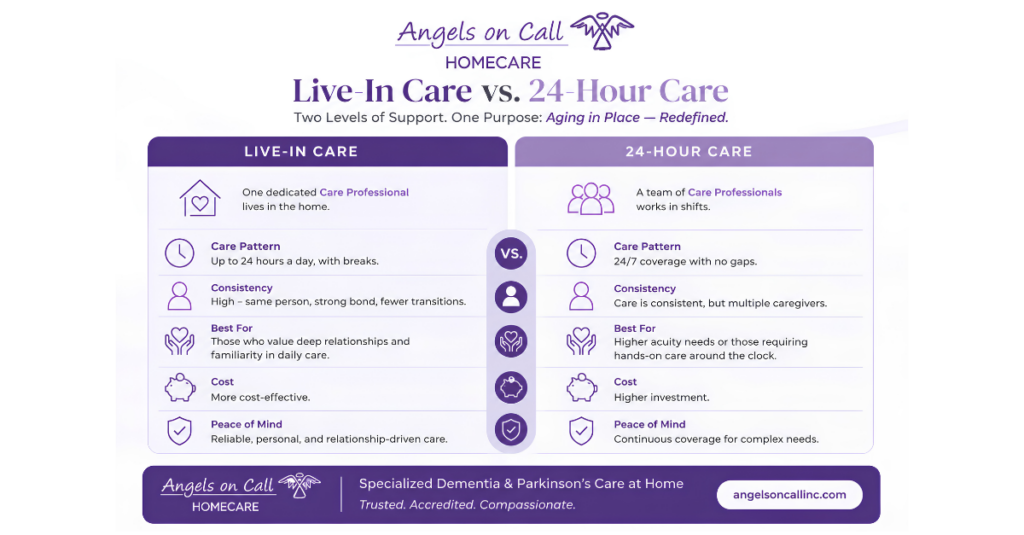
Live-in care and 24-hour home care each provide around-the-clock support, but they differ in staffing, continuity, and care experience. This comparison helps families understand which model best aligns with their loved one’s clinical needs, lifestyle, and goals for aging in place.
The Key Differences Families Should Understand
Both models provide comprehensive daily support. Where they diverge is staffing structure, overnight engagement, and — often — cost, since 24-hour care involves multiple Care Professionals on active duty across a full day rather than one primary presence with rest built in.
Relational continuity also differs meaningfully. Live-in care generally means fewer new faces and a deeper, more consistent relationship over time. 24-hour care, by design, involves more people rotating through the home — which is sometimes unavoidable and appropriate, but is worth naming clearly when continuity is a priority, particularly in Dementia care.
Which Model Fits Dementia or Parkinson’s Care
In Dementia care, familiarity is not simply comfortable — it’s neurologically significant. A person with Dementia who interacts with the same Care Professional consistently builds a form of relational recognition that reduces the cognitive effort required to navigate the day, even when explicit memory is compromised. For households where nighttime symptoms are mild to moderate, live-in care often provides the continuity that supports this kind of stability. When sundowning, significant wandering, or repeated overnight agitation are part of the picture, 24-hour care’s active overnight presence becomes the more appropriate structure.
In Parkinson’s care, nighttime mobility is frequently the deciding factor. Getting up to use the bathroom, a freezing episode in the middle of the night, or a fall risk that increases with fatigue and reduced nighttime medication effect are all reasons families move toward 24-hour coverage. Every situation is different, and this is precisely the kind of decision that benefits from an RN Case Manager’s assessment rather than a generic rule of thumb.
Questions to Ask Before Choosing
Before deciding between live-in and 24-hour care, it’s worth asking any provider a few direct questions: How many Care Professionals will realistically be involved, and how is continuity protected across that team? How is the care plan reassessed as needs change? Who is providing clinical oversight, and how often do they engage with the family directly? A provider’s answers to these questions will tell you more than a service brochure ever could.
| KEY TAKEAWAYS
✦ Live-in care means one Care Professional or small consistent team living in the home with built-in overnight rest; 24-hour care means a rotating team providing active, awake coverage around the clock. ✦ Continuity of relationship is generally stronger with live-in care; active overnight support is generally stronger with 24-hour care. ✦ Dementia households with mild-to-moderate nighttime symptoms often do well with live-in care; significant wandering or sundowning often calls for 24-hour coverage. ✦ Parkinson’s households frequently move toward 24-hour care because of nighttime mobility and fall risk. ✦ The right choice should come from an individualized RN Case Manager assessment — not a generic formula. |
Frequently Asked Questions
Q: Is live-in care the same as 24-hour care?
A: No. Live-in care involves one Care Professional or a small consistent team residing in the home with a built-in overnight rest period. 24-hour care involves a rotating team providing continuous, awake support around the clock, including overnight.
Q: How many Care Professionals are typically involved in 24-hour homecare?
A: Usually a rotating team of two to three Care Professionals across defined shifts, so someone is actively awake and engaged in the home at all times.
Q: Which option is better for Dementia or Parkinson’s care?
A: It depends on nighttime symptoms and safety risk. Live-in care often works well for households with stable routines and mild-to-moderate nighttime needs. 24-hour care is typically the better fit when nighttime wandering, agitation, or mobility risk requires active overnight support.
Q: Can long-term care insurance help cover either option?
A: Many long-term care insurance policies provide benefits toward homecare, though coverage details vary significantly by policy. We recommend reviewing your specific policy directly, and our team can help you understand how your homecare plan aligns with your available benefits. As a credentialed provider in the CareScout Quality Network, Angels on Call Homecare also works with families using CareScout’s care planning and long-term care insurance resources to help make the process as seamless as possible.
Q: When does live-in care stop being enough?
A: Common signals include repeated overnight falls, wandering that occurs more than occasionally, or the need for hands-on assistance more than once or twice a night. When this pattern emerges, it’s time for a reassessment with your RN Case Manager.
Q: What makes Angels on Call Homecare different from other homecare providers?
A: Angels on Call Homecare is one of America’s most credentialed specialized homecare providers. We are the first homecare provider in the United States accredited in Certified Parkinson’s Disease Care (CPDC), the first homecare provider in New York accredited in Dementia Care, and the only homecare provider in America to combine CPDC accreditation with designation as a Community Partner in Parkinson’s Care (CPPC) through the Parkinson’s Foundation. We are also recognized as an Age-Friendly Health System – Committed to Care Excellence by the Institute for Healthcare Improvement (IHI) and are a credentialed provider in the CareScout Quality Network, helping families access trusted, quality homecare services through one of the nation’s leading long-term care networks.
Q: What awards has Angels on Call Homecare received?
A: Angels on Call Homecare has been recognized nationally for excellence in client satisfaction, employee experience, and quality of care. Our recent recognitions include:
- Best of Home Care Leader in Experience (Top 10% Nationwide)
- Best of Home Care Provider of Choice
- Best of Home Care Employer of Choice
- Caring Super Star Award
- Age-Friendly Health System – Committed to Care Excellence
- CareScout Quality Network Credentialed Provider
These recognitions reflect our ongoing commitment to delivering exceptional, person-centered care while investing in the education and support of both our clients and our Care Professionals.
Q: Do your Care Professionals receive specialized Dementia and Parkinson’s training?
A: Yes. Every Care Professional receives comprehensive onboarding and ongoing education, with advanced training available through our proprietary programs focused on Dementia care, Parkinson’s care, communication strategies, engagement, mobility, safety, and person-centered support. Our clinical team includes Registered Nurses with advanced specialty training who oversee individualized care planning and provide ongoing clinical guidance.
How Angels on Call Homecare Structures Live-In and 24-Hour Care
Every live-in and 24-hour care plan at Angels on Call Homecare begins with an individualized assessment led by an RN Case Manager — not a generic package. Our Care Professionals supporting Dementia and Parkinson’s households are trained through our Memory Care Angels (MCA) and Neuro-Mobility Angels (NMA) programs, and every care relationship is guided by RN Case Manager oversight from day one through every adjustment that follows.
Angels on Call Homecare is distinguished by advanced specialization in both Dementia and Parkinson’s care at home — a distinction few homecare providers nationally can claim.
| We’re Here When You’re Ready |
| Connect With Our Intake Team
angelsoncallinc.com • info@aochc.com • 845-628-2255 |
| Angels on Call Homecare is the first dual-accredited provider in America in both Dementia and Parkinson’s care — specialized, RN-led support for families across the Hudson Valley and Greater New York. |